A Defining Moment: Reflections on the Society of Christian Scholars' Global Leadership Conference in Nairobi
By Dr. Orville Plummer, Chair, Global Leadership Conference
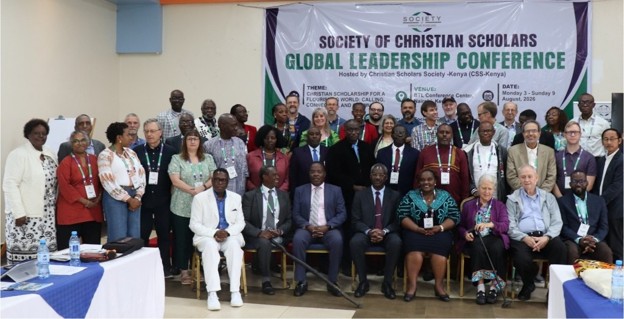
From August 4–8, 2026, the Society of Christian Scholars gathered in Nairobi, Kenya, for what I believe will be remembered as a defining moment in the history and development of our global movement. The inaugural Global Leadership Conference brought together members of the Executive Committee, Global Scholars Leadership Team, Regional Representatives, leaders of national movements, founding members, strategic partners, and other stakeholders around the theme, ‘Christian Scholarship for a Flourishing World: Calling, Connection, and Community.’
As Chair of the Conference, I left Nairobi with an overwhelming sense of gratitude to God. What we experienced was much more than a conference. It was a gathering of a global family, a meeting of minds and hearts; a time of worship, scholarship, fellowship, discernment, and strategic envisioning; and a reminder that God is building a worldwide community of Christian scholars for His Kingdom purposes.
A Global Family Gathered in Kenya
One of the most memorable features of the conference was its remarkable international, multiracial, multicultural, and multidisciplinary character. Participants represented Africa, Asia, the Middle East, Latin America, the Caribbean, North America, Europe, and emerging regions. We came from different nations, cultures, ethnicities, academic traditions, disciplines, and institutional settings, yet our deepest identity and strongest bond were found in Jesus Christ.
Around tables, in plenary sessions, during worship, over meals, in working groups, and through informal conversations, scholars and leaders shared experiences and perspectives. The diversity did not divide us; it enriched us. The Society’s mission to equip Christian academics to have a missional and redemptive influence for Christ among their students, colleagues, institutions, and academic disciplines, was visibly embodied in the people gathered in Nairobi.
The Warmth of Kenyan Hospitality
Our experience was made even more memorable by the extraordinary hospitality of our Kenyan hosts. From arrival to departure, we encountered generosity, warmth, kindness, attentiveness, and a genuine desire to make us feel at home.
The hospitality extended beyond efficient conference arrangements. It was relational. We were welcomed not merely as international visitors but as brothers and sisters. Meals became occasions for conversation, tea breaks became opportunities for connection, and the spaces between formal sessions became some of the most meaningful moments of the conference.
Kenya gave us more than a venue; Kenya gave us a welcome. We remain deeply grateful to the Local Organizing Committee, our hosts BTL Conference Center, partners, donors, and everyone who contributed to making our stay so memorable.
Mutual Edification: Giving and Receiving
The conference intentionally integrated spiritual formation with academic excellence, creating space for worship, biblical reflection, prayer, intellectual engagement, relationship building, scholarly dialogue, and corporate discernment.
This created an atmosphere of genuine mutual edification. We taught one another, but we also learned from one another. We spoke, but we also listened. We shared successes while honestly confronting challenges. Daily worship and biblical reflection reminded us that Christian scholarship cannot be separated from Christian discipleship.
The conference renewed our conviction that the Society must continue developing scholars who are not only academically excellent but also spiritually mature, biblically grounded, missionally engaged, culturally sensitive, and committed to the flourishing of their institutions and societies.
Inspiring Plenaries and Scholarly Presentations
The intellectual content of the conference was stimulating and inspiring. Keynote and plenary presentations explored the calling, heart, connection, and community of Christian scholarship.
Among the programme highlights were Professor J. Richard Middleton on ‘The Vocation of the Christian Scholar: Called to Image God’; Professor Danny McCain on ‘The Heart of Christian Scholarship’; Professor Damaris Parsitau on ‘Connection in a Fractured World: A Call to Witness and Human Flourishing’; and Professor David Wilkinson on ‘Christian Scholarship for a Flourishing World’.
The scholarly paper presentations added further depth, allowing participants to present research, ask questions, exchange perspectives, and learn across disciplines. Program 500’s emphasis on writing and publishing for impact also reinforced the Society’s commitment to rigorous scholarship that contributes meaningfully to the global academy.
Networking, Fellowship and Friendships
Some of the conference’s most enduring outcomes may never appear in a formal report. They are the relationships and friendships formed. Names became faces, and faces became friends. Scholars who had communicated electronically finally sat together, shared meals, prayed, laughed, exchanged stories and ideas, and envisioned possibilities for collaboration.
The programme deliberately provided opportunities for networking, collaborative research discussions, publication initiatives, strategic meetings, and fellowship. These relationships are critical because a global movement cannot be sustained by structures and programmes alone. It must be built upon trust, friendship, shared mission, mutual respect, and Christian fellowship.
Umoja: The Spirit of Oneness
One word that beautifully captures our experience is the Swahili word Umoja: oneness or unity. Our nationalities were different, but our Lord was one. Our cultures were different, but our calling was one. Our disciplines were different, but our mission was one. Our national and regional challenges differed, but our hope was one.
This spirit complemented another Kenyan ideal reflected in the conference preparation: Harambee, ‘all pulling together.’ Together, Umoja and Harambee capture what we experienced: oneness of heart expressed through collaborative action. The future of the Society cannot be built by one region, culture, discipline, or small group of leaders. We need one another.
Envisioning the Future
Friday’s ‘Envisioning the Future’ sessions represented one of the conference’s most strategically important components. They moved us intentionally from celebration and reflection toward discernment and action.
Working groups addressed areas including branding and marketing; leadership identification and development; curriculum and research development; mentorship and emerging scholars; spiritual formation; and growth, expansion, institutional partnerships, and exchange programmes.
The recommendations emerging from these deliberations provide important guidance for the Society’s future strategic direction. They point toward stronger leadership pipelines, deeper spiritual formation, enhanced research capacity, intentional mentorship, stronger organizational systems, expanded partnerships, improved communication, and thoughtful global growth.
The real test of Nairobi will therefore be what happens after Nairobi. We must translate recommendations into priorities, priorities into plans, plans into action, and action into measurable Kingdom impact.
The Beauty of Kenya
After several intense days of worship, scholarship, discussion, and strategic planning, Saturday’s safari provided a refreshing and unforgettable conclusion. Our visit to Nairobi National Park and the Maasai Market allowed participants to experience another dimension of Kenya.
The magnificent scenery, African landscape, wildlife, open spaces, and natural beauty reminded us of the majesty and creativity of God. Away from the conference rooms, relationships continued to deepen as we travelled, talked, laughed, took photographs, and experienced Kenya together.
A Personal Pilgrimage and Ministry Milestone
On a personal note, the conference constituted one of the most significant milestones of my life and ministry. Firstly, as a person of African descent, visiting Kenya carried a significance far beyond international travel. There was a profound sense of pilgrimage in setting foot on my ancestral motherland. To experience Africa, its people, culture, landscape, hospitality, vitality, and Christian witness, was deeply moving. The journey connected the professional and ministerial purpose of the conference with something profoundly personal.
Secondly, I count it an extraordinary privilege that the conference gave me the awesome opportunity to preach the Word of God in Kenya at Christ Is The Answer Ministries (CITAM). To stand in an African pulpit and proclaim Jesus Christ was a highlight of my ministry and an experience for which I will remain deeply grateful to God.
These experiences made Nairobi not merely a place where I chaired a conference, but a place that will remain permanently etched upon my heart.
A Conference Highly Valued by Participants
It was especially encouraging that the conference evaluation reflected a very high level of participant satisfaction. The high scores and positive responses affirmed the value participants placed on the programme, presentations, fellowship, organization, intellectual engagement, and overall conference experience.
While every gathering provides lessons for improvement, the evaluations confirmed what was evident throughout the week: participants regarded Nairobi as a meaningful, worthwhile, and highly successful global gathering.
Nairobi Was a Defining Moment
As I reflect on the Global Leadership Conference, I am convinced that Nairobi should not be remembered merely as an event successfully completed. Nairobi was a defining moment in the history of the Society of Christian Scholars.
We arrived from many nations and left with a stronger sense that we belong to one global movement. We arrived with national and regional perspectives and left with a larger global vision. We arrived as colleagues and left as friends. We arrived asking questions about the future and departed with emerging strategic directions.
My prayer is that relationships formed in Nairobi will become enduring partnerships; conversations will become collaborative projects; recommendations will become strategic initiatives; emerging scholars will become future leaders; and the regional and global movements will become stronger.
May we preserve the spirit of Umoja, oneness. May we embrace the spirit of Harambee, all pulling together. And may the Society of Christian Scholars move confidently into its next chapter, united around Christ and committed to Christian scholarship for a flourishing world: Calling, Connection, and Community.
To God be the glory.
Upcoming Opportunities

Online Conference Hosted by European Hebrew Journal
The conference, New Discoveries and New Directions in Biblical, Hebrew, and Theological Studies, will take place online from 6–10 November 2026 and bring together more than 60 international scholars and researchers. Across five days, the programme moves from biblical archaeology and new discoveries from the ancient world to Hebrew Bible and Biblical Hebrew, Qumran and Second Temple Judaism, manuscript traditions and textual criticism, and the reception and interpretation of biblical texts in Jewish, Christian, and wider religious traditions. The final sessions broaden the discussion toward theology, early Christianity, language, history, and new directions in biblical scholarship. With approximately 60 scholarly sessions, live discussion, and contributions from researchers working across Europe, Israel, North America, Africa, and beyond, the conference is designed to highlight both major recent discoveries and emerging approaches to the study of the Bible, Hebrew language and literature, and related fields. The full programme is available below.
The Program on Biblical Law and Christian Legal Studies at Harvard has a few upcoming events:
The Program on Biblical Law and Christian Legal Studies is committed to being a part of God’s unfolding story at Harvard and beyond, and is called to ‘make ready a people prepared’ (Luke 1:17).
This summer we prayed by name for many of you — those returning, those arriving for the first time, and those who graduated recently or long ago. We’ve loved meeting incoming students, researchers, and faculty, and hearing how each one felt providentially led to Harvard.
October 15 — annual Law & Faith Lecture, featuring Professor Molly Worthen, exploring the place of Christian faith in our cultural and institutional life, and how charisma has shaped America.
A full listing of public events happening this fall is available:
The Spiritual Formation Group, led by Dr. Nita Kotiuga, meets on the second Wednesday of every month. The next meeting, on Wednesday, 14 October at 1400 UTC, will continue to explore various forms of experiencing God together through prayer. Have your Bible readily accessible as well as pen and paper, because writing notes by hand slows us down and helps us express more accurately how we feel. If you have any questions, please contact Dr. Kotiuga at nita.kotiuga@bgu.edu.
Society Library
The Library Reading Group will meet on Friday, 2 October at 1400 UTC. Led by Dr Peter Schuurman, the group will discuss his article, ‘Cracks in the Secular University Establishment: Growing Post-Secular Options in Canadian Higher Education’. Be sure to register to attend the group. Should you have any questions, contact Dr Marlene Hines, the Society Librarian, at mhines@societyofchristianscholars.org.
This month’s Library Reading Corner includes an annotated bibliography of five library resources under the library categories: Theology and Academy and Interacting with Culture(s) and Society.
These resources provide further reading from the August 2026 webinar by Prof. Chammah J. Kaunda, ‘Participating in a ‘Living Tradition’: Relational Creedal Orthodoxy in an Age of World Christianity’.
1. The Echo of Nicene Faith: A Decolonial Pentecostal Back-gaze by Chammah J. Kaunda
Brief Description: This article presents a critical analysis of the Nicene Creed within the context of African Christian theology, the history of Christianity and the church in Africa and the influence of the western world with focus on the Roman Empire and the contribution of Christian scholarship in the debate.
2. The New Testament and the Nicene Dogma: A Contribution to the Recovery of Theological Exegesis by David S. Yeago
Brief Description: This article presents the author’s ‘contribution to an argument that the ancient theologians were right to hold that the Nicene homoousian is neither imposed on the New Testament texts nor distantly deduced from the texts, but rather describes a pattern of judgements present in the texts, in the texture of scriptural discourse concerning Jesus and the God of Israel’.
3. ‘In the Name of the Father, Son and Holy Spirit: Teaching the Trinity from the Creeds to Modern Discussion’, edited by Thomas K. Johnson, David Parker, and Thomas Schirrmacher
Brief Description: This publication is Vol.17 of the World Evangelical Alliance, World of Theology Series which includes 7 articles which are focused on the development of an understanding of the missional and transformational impact of the Christian theological concept of the Trinity or the Triune God throughout Christian history as recorded in both the Old & New Testament and more recent records of man’s experience with God.
4. ‘On the Homoousia: The Liberative Potential of the Nicene Creed’ by Joerg Rieger
Brief Description: This article examines the theological foundation and significance of the Nicene Creed in terms of its ‘imperial pedigree’ the emergence of a ‘Roman Christian identity’ and its contribution to the liberation theology movement.
5. The Nicene Creed: An Introduction by Phillip Cary
Brief Description: The audience of this book is the ‘Christians who want to understand their own faith better, and to…grow in the knowledge of God by learning what the ancient teachers of the Nicene faith had to give us’.
Upcoming Webinar
Be sure to check the Webinars Page for third-party webinars that are often added on short notice and for updated presenters and topics that may be helpful in equipping you to bring the gospel to bear in your university context.

Dao, Non-Action, and Immortality: A Comparative Inquiry into Biblical and Daoist Texts by Andrew Yan – Thursday, 15 October 2026 at 1400 UTC
Are there any connections between ancient Daoist texts and the Bible that may serve as a bridge to communicate the gospel of Christ and foster wisdom and understanding of human beings in a Chinese context?
On Thursday, 15 October 20206 at 14000 UTC, Dr Andrew Yan will explore three foundational themes shared by Daoist and Christian traditions: ultimate reality, spiritual practice, and human destiny. Structured around the progression of Dao → Non-Action (Wuwei) → Immortality and Logos/God → Grace → Eternal Life, it examines both parallels and differences between classical Daoist texts and the Bible.
The first section compares the Dao of the Daodejing with the Logos of the Gospel of John as principles of cosmic origin and order. The second considers the Daoist ideal of wuwei alongside biblical teachings on grace, surrender, and life in God, highlighting their shared critique of ego-driven striving. The third explores Daoist notions of immortality and Christian understandings of resurrection and eternal life. Finally, the talk reflects on the Daoist sage and the Christian saint as parallel models of transformed humanity. Rather than conflating the two traditions, the presentation seeks to foster a deeper dialogue concerning wisdom, spiritual transformation, and humanity’s ultimate destiny.
Dr Andrew (Zhonghu) Yan is a scholar of comparative philosophy and religion, holding advanced degrees from Brown University (M.A.) and the University of Toronto (Ph.D.). He is the author of the pioneering work An Existential Reading of the Confucian Analects (Cambria Press, 2011), which opened new avenues for dialogue between Confucian thought and existential theology. Dr Yan is also a sought-after speaker, known for his insightful explorations of the intersections between Daoist and Christian traditions. He currently teaches Chinese philosophy at the University of Toronto and serves as an instructor at the Canadian Chinese School of Theology at Tyndale University.
Disclaimer: The views and opinions expressed in the Addenda are those of the authors and do not necessarily reflect the views or positions of the Society of Christian Scholars.