Update on Society's Conference
Update on the August Society Conference
After careful reflection and prayer, the Society of Christian Scholars has decided to modify the format of this year’s August conference in Nairobi, Kenya. Rather than a full public, in-person conference, we will convene a smaller, invitation-only gathering of Society leaders from around the world for focused internal conversation and strategic planning.
Accepted academic papers will still be presented virtually as part of the conference program.
We look forward to hosting a future full-scale, in-person conference and hope to engage many of you then. We appreciate your understanding and continued support of the Society’s mission to foster thoughtful, Christ-centered scholarship.
Lent: Living into our Baptismal Identities
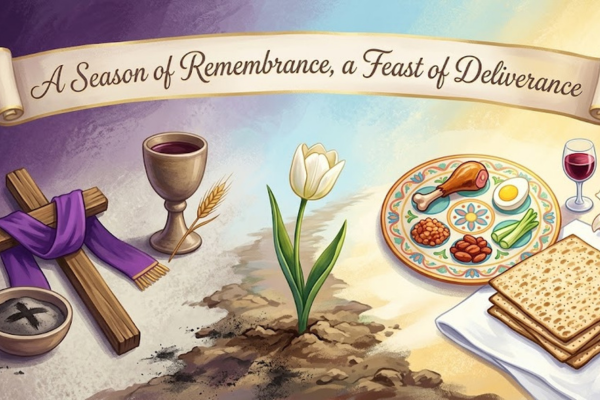
Calendars are the autobiographies of a nation. They celebrate our ideals and idols: national heroes, wars and whispers of wars, iconic food days, and now (in the US) Black Friday – a whole day dedicated to shopping. This is indeed a vivid commentary on what is important to our country.
The church calendar offers a different narrative around which to shape our lives. It does not replace the other calendar, but it gives us a way to navigate it. It offers us a way of resistance. It is the story of Jesus as now lived by the church. His biography has become our autobiography.
To know the heart of Jewish theology, you can just look at their calendar. Every Jew was shaped by the Scriptures as they were lived out annually in the fasts, festivals, and feasts of this small nation. And to the utter astonishment of the nations in which they resided, they stopped work for one whole day. Why? Because they were not owned by the nation, their sense of duty, their home repair projects, or their sports schedules. They were God’s. There was no better way to live this out than by living into God’s spaciousness, even when in exile. This reminded them that at the heart of things, no matter where they lived or what was going on around them, they marched to a different interior drum. One that beat with God’s own heartbeat.
Jesus lived every one of these festivals. And so did the early Christians, but with a new understanding of them. The Jewish calendar was a portrait of Jesus! This had been hidden in the calendar all along! This was the momentum toward which it had always moved, and it told his story as well as that of the nation’s. And now, because Jesus was the head of the body, it was their story as well: slavery, life-blood, miraculous rescue, freedom. They had been freed from the slavery of Satan, through the voluntary life-blood of the Paschal lamb. They had been miraculously rescued from sin and death, and they now lived by his Spirit as the firstfruits of a new creation.
So it is not surprising that the early Christians (many of them Jewish) continued to celebrate these Jewish festivals, to keep the story alive and to celebrate what had happened (and continued to be happening) to them. Now, if they were keeping the Jewish festivals in the “old way,” as Paul said, with further limitations and scrupulosity, then this would not be the true Jesus narrative. But we see Paul re-interpreting the Jewish process of making bread in this new light (1 Cor 5:7), as well as taking the old rituals and welcoming new Christians into their new interpretation (1 Cor 7:19, Rom 2:29).
In its infancy, before the writing of the Gospels and the spread of the epistles, the early church continued to reflect on the Jesus story through the Old Testament Scriptures as its guide to understanding the Christ event. Through mining the Old Testament, a theology emerged that told the Jesus story according to the keys and treasures hidden therein. This is what the apostles did. And in the following generations, so did Melito in Sardis, and Irenaeus as a missionary to France, and Ignatius as he was put in chains and dragged across Asia Minor to Rome for execution. These ancient Hebrew Scriptures with their national feasts and festivals were the key to the early church’s burgeoning theology of Jesus, and to understanding themselves.
We have firm evidence that John the disciple stayed in Jerusalem after Jesus’ ascension, continued celebrating Passover with the Jews, and taught his disciples the inner meaning of the Passover. They kept the Jewish calendar and gloried in all the new ways their Lord was revealed to them through the feasts. When Rome crushed Jerusalem, the exiled Jewish believers took these celebrations with their new understanding around the Roman Empire.
Controversy over the Paschal celebration within the early church resulted from a conflict in calendar. Other Christians celebrated the Paschal mystery on Sunday (the ‘Lord’s Day’), while John and his disciples, fresh from Jerusalem, had been celebrating it on the exact day of Passover (the 14th day of the lunar month) with all the Jews. (They were dubbed the ‘Fourteeners,’ not exactly a term of endearment.) Eventually, the Bishop of Rome became involved and decided to excommunicate all the ‘Fourteeners.’ Aside from unwillingness to live with differences, the most important thing to note here is that the impulse to celebrate, remember, and keep alive the Jesus story not just in hearts but in a calendar was present from the start. The issue seemed important enough to lead to excommunications and division.
As the Christian church matured in its ongoing reflections on Jesus Christ (and therefore upon itself as the body of Christ), festivals of ‘incorporation’ into Christ erupted spontaneously all over the known world. We find Christians in Syria celebrating baptisms in an annual festival, for which long preparations were necessary. The same occurred in North Africa, but on a different date. Italy, Gaul (France), Turkey – everywhere the local church grew, it undertook the celebration of this incredible mystery of becoming part of Christ. These celebrations helped new believers not only prepare to become his body, but also receive his body at the Lord’s table. No one was allowed to the Lord’s table who had not been baptized. This extended beyond converts to the entire church as they structured their own annual calendar around receiving these new members who, in a mysterious way, were now part of each other because they were part of Christ. This corporate preparatory journey varied from place to place, but its Jewish roots are apparent: fasting, prayer, repentance, Scripture, and generosity to the poor. And like the Old Testament festivals, the corporate journey gave birth to the ‘Christian calendar’ – a calendar of festivals of incorporation into Christ.
Before Constantine, the Christian festivals were unregulated and uncoordinated, and their practice reflected local custom and spirituality. The emphasis in North Africa and the West tended to be upon baptism as death and resurrection, or ‘tomb spirituality,’ grounded firmly in Paul’s teachings on baptism. Baptisms in the East, conversely, tended to reflect language of rebirth, or ‘womb spirituality,’ grounded firmly in Jesus’ words to Nicodemus, ‘you must be born again,’ as well as Jesus’ own baptism. The ‘tomb spirituality’ of baptisms in the West eventually found a home around the Paschal weekend of Easter, and the multiple and uncoordinated weeks of preparation became an agreed-upon forty-day time. Athanasius, as bishop in the fourth century, took it upon himself to send an annual letter to all his churches, announcing the day of Easter and the commencement of the preparation season – Lent. The ‘womb spirituality’ of the Eastern churches clustered around January, while the celebration of Christ’s own nativity and baptism centered on Epiphany. These churches also undertook a season of preparation together, which eventually became Advent in the early Middle Ages.
Lent is the long-established way to remember and celebrate our own baptisms. For forty days we walk alongside Jesus as he himself dwelt upon the word just given to him in his baptism from the Father, ‘You are my beloved Son.’ This word gave him strength to resist the devil, as Jesus retorted, ‘Man shall not live by bread alone, but by every word that comes from the mouth of God.’ We too have been given this word in our baptisms. We too are given forty days to feast upon this word, and to repent of all things that compromise our hearing and living into this central reality of who we are in Christ. Fasting might help us, as it did Jesus, to refocus our attention on this central word. Fasting from other words (even our ‘Christian work’ and its call upon our life) might also help us focus on this one most central thing. For those of us in any position of leadership as Christians – scholars, professors, teachers – it is an ongoing temptation to mistake our second identity (our vocation) for our first identity (as beloved in Christ). But if we do this, we are doing the devil’s work, even in the midst of our Christian work.
True Lenten spirituality is not self-flagellation but ridding ourselves of all things that compromise our baptismal identity. This Lent, let us turn to him and have our disordered loves exposed, that we might receive the love of the Father for us, in Christ afresh. The Lenten desert does not exist to expose us, but to heal us.
By Dr. Julie Canlis
Dr. Canlis is liturgical director for Trinity Church, Wenatchee, and an adjunct faculty member at Whitworth University. Her current research focuses on liturgical calendars. She has also previously published two books: A Theology of the Ordinary and Calvin’s Ladder.
Editorial Services Testimonials
Using the Society of Christian Scholars’ editorial service for my English text editing was a truly valuable experience. As someone working in an academic setting, I often find that expressing complex ideas clearly and fluently in English can be a challenge—especially when aiming for publication-quality writing. The editor not only corrected grammatical and stylistic issues but also enhanced the overall clarity and flow of my work by asking questions and proposing valuable suggestions, making it more accessible to an international audience.
What I appreciated the most was the editor’s attention to detail and the constructive suggestions provided throughout the editing process. This experience not only strengthened my final text but also helped me become more aware that I need to share more context for the international readers. Overall, it was an excellent help, and I really appreciate the editor’s service.
By Dr. Kristina Ecis
Academic Dean, Latvijas Bībeles centrs
Upcoming Opportunities
Next Spiritual Formation Meeting
The Spiritual Formation Group, led by Dr. Nita Kotiuga, meets on the second Wednesday of every month. The next meeting, on Wednesday, 8 April 2026 at 1400 UTC, will continue to explore various forms of experiencing God together through prayer. This will be a time of listening and teaching, followed by sharing. Depending on the type of prayerful experience being explored, meetings will last 1 to 1.5 hours.
Be sure to have your Bible readily accessible as well as pen and paper, because handwriting slows us down to help us express more accurately how we feel. If you have any questions, please feel free to contact Dr. Kotiuga at nita.kotiuga@bgu.edu.
The Calvin Institute of Christian Worship Summer Seminars
The Calvin Institute of Christian Worship is excited to offer three opportunities to participate in a summer seminar this year. CICW’s summer seminars provide space for a diverse group of ministry leaders to study and engage with critical issues related to worship, ministry, and church life—all in a restful environment built for reflection and connection. Applications are due by March 15. The only cost for accepted participants is travel to and from Grand Rapids, Michigan. All meals and lodging are provided.
Take a look at the seminars offered below and visit our website for full details and application information.
1. Forming Communities of Witness in Post-Christian Contexts
June 22–26, 2026
An application-based summer seminar directed by Mark Glanville that explores how to move beyond cookie-cutter approaches to pastoral leadership to build the creative, compassionate, and incarnational churches we long for.
2. Brown Church: Five Hundred Years of Worship and Witness
July 27–31, 2026
An application-based summer seminar directed by Robert Chao Romero that explores what the wider church can learn from stories of Latino/a Christians through five centuries of faith.
3. Living the Scriptural Story
August 3–7, 2026
An application-based seminar directed by Carmen Joy Imes that will explore the resources of biblical theology for the life of the church with a focus on key themes of being God’s image, bearing God’s name, and becoming God’s family.
Society Library
Calling all book reviewers! If you would like to write a 1000-word review of one of the following books for the Society, reach out to the Society’s book review editor, Dr Ron Lindo (rlindo@societyofchristianscholars.org) and he will make sure you receive a copy of the book for review.
1. Jordan Peterson, We Who Wrestle With God: Perceptions of the Divine (Penguin Random House, 2024).
Peterson seems to be suggesting that we should ponder the biblical stories for the sake of adjusting our perceptions of the world.
2. Elmer John Thiessen, Healthy Christian Minds: A Biblical, Practical, and Sometimes Philosophical Exploration of Intellectual Virtues and Vices (Cascade Books, 2024).
This book focuses on how to use our intellect for spiritual development and the cultivation of godly virtues, not simply for the sake of processing more information.
3. Jacob Shatzer, Faithful Learning: A Vision for Theologically Integrated Education (B&H, 2023).
This book provides a survey of the major Christian doctrines and how each academic discipline might be related to one of these doctrines.
4. Carl McColman, Read the Bible like a Mystic: Contemplative Wisdom and the Word (Broadleaf Books, 2025).
Taken from the back cover: “Can the Bible be saved? More and more Christians are troubled by how difficult passages in the Bible can be used to promote sexism, homophobia, hostility to other faiths, and other problems–but a sterile, “academic” reading of the sacred text seems spiritually unfulfilling.
McColman reminds us that there is an ancient “third way” of approaching the Bible: reading scripture like a mystic. This contemplative approach to the Bible understands that much of the sacred text was never meant to be taken literally, yet this approach maintains that spiritual wisdom, guidance in prayer, and encouragement for meditation are encoded throughout the sacred text.”
5. Todd Korpi, AI Goes to Church: Pastoral Wisdom for Artificial Intelligence (IVP, 2025).
In this book, Korpi explains how the integration of AI into modern society can be useful to pastors and church leaders. Korpi examines how AI should be filtered through five main aspects of the Christian life: theological implications, ethical applications, practical applications, how it might be used missionally, and how it might be used hopefully.
6. Douglas Jacobsen and Rhonda Hustedt Jacobsen, Christian Higher Education: A Global Reconnaissance (Eerdmans, 2014).
This book surveys the development of Christian practices in higher education across the globe. Areas covered include Kenya, China, Korea, India, Mexico, Brazil, Canada, the United States, and Europe.
7. Robert J. Joustra, Christ and Covenant in Global Politics: A Christian Introduction to International Relations (IVP, 2026).
Taken from the back cover: “Robert J. Joustra presents a Christian framework for international relations, replacing fear-driven systems with a “covenantal global community” based on ordered love. It advocates for a faith-driven, pluralistic approach to global justice, challenging secular international relations theory and promoting responsible, obedient statecraft.”
8. John Azumah, My Neighbour’s Faith: Islam Explained for Christians (Hippo Books, 2019).
Nowhere else in the world has the near equal influence of both Islam and Christianity shaped the history of a people and their way of life more than in Africa. Conflicts involving Christians and Muslims in places like Sudan, Nigeria and Ivory Coast are common. These conflicts are fueled primarily by ignorance, stereotyping and prejudice, which in turn breed fear, suspicion and even hatred, in some cases leading to violence. My Neighbour’s Faith sheds light on the beliefs and teaching of Islam by addressing matters of contemporary importance to Christians and the wider non-Muslim audience.
This month’s Library Reading Corner feature, includes an annotated bibliography of five library resources under the library categories; Theology and Academy, Pursuing Vocational Excellence, and Growing Spiritually. The website of the Dictionary of African Christian Biography (DACB) can also be accessed via the Library’s Special Collection and Quick Reference Guide.
These resources provide further reading related to the January 2026 webinar, ‘African Christian Biographies,’ by Dr Michèle Sigg,
1. Dictionary of African Christian Biography edited by Michèle Sigg
This website emerged from a project that aims to recover, preserve and disseminate the biographies of historical African Christian leaders, both male and female. The project seeks to provide evidence, derived mainly from oral communication, of the contribution of African Christian history to global Christian history.
2. The Dictionary of African Christian History and the Story of Ethiopian Christianity by Michèle Sigg
This journal article includes stories of African Christian leaders who have made an impact on the people of ancient African societies. The author present information on Ethiopian Christians.
3. Historical Sources of Christian Religious Leadership Ideology: implications and challenges for social transformation in post-military Africa by Obaji M. Abiji and Ignatius Swart
This journal article “develops a more informed identification of the historical sources that have shaped the leadership ideology of Nigerian Christian leaders.” Christianity is discussed as an indigenous religion of Africa but is also treated as a religion introduced to Africa long after the evolution of African traditional religions but before Islam.
4. Rainisoalambo, Ravelonjanahary, and Volahavana Germaine (Nenilava): Revival Leaders of Madagascar by Berthe Raminosoa Rasonanalimanga
This biographical article includes information about three African Christian leaders from 18940 to 1998 who were instrumental in one of the earliest Christian movements in Africa, the Fifohazana (or “Awakening”) movement on the island of Madagascar.
5. African Christianity: An Overview by Ogbu U. Kalu
This is Chapter 2 of the book African Christianity, which provides a detailed overview of the origin of Christianity in Africa. It highlights the story of the infant Jesus taking refuge in Africa; an event that is celebrated annually in the African Coptic Orthodox Church, and the impact of Western Christianity on Christian practice in Africa.
Upcoming Webinar
Be sure to check the Webinars Page for third-party webinars that are often added on short notice and for updated presenters and topics that may be helpful in equipping you to bring the gospel to bear in your university context.
Can the Press Be Reformed? by Michael Ray Smith — Thursday, 19 March 2026 at 1400 UTC
In this presentation, Dr Smith will examine an experiment that captured the attention of the world. The Rev. Charles M. Sheldon, often cited for his “What Would Jesus Do?” question, took over a daily American newspaper—the Daily Capital in Topeka, Kansas (USA)—in 1900 to demonstrate how a mainstream newspaper should read if it were committed to privileging Christ as the editor. Readers from around the globe obtained copies of the experiment, which included front-page sermons, along with news free from political references or anything that Sheldon considered ungodly. Sheldon used his best-selling novel, In His Steps, as a blueprint for his model newspaper. The key to Sheldon’s experiment was his counter-cultural approach to editing a mainstream newspaper.
Smith will use Bormann’s symbolic convergence theory to identify the ways in which Sheldon’s work spoke to Christians hungry for an alternative to the Western approach to publishing, characterized by a kind of scientific, positivism-driven examination of the facts. Sheldon’s short-lived experiment didn’t catch on in the United States or elsewhere, but it served as a strong attempt to reform a press that ignores a desire to understand the spiritual as well as the material world.
Dr Smith is a renowned author and adjunct professor of journalism at Olivet University. He was formerly Professor of Journalism at LCC International University in Klaipeda, Lithuania and also taught at Regent University in the USA. He spent a decade writing for mainstream newspapers including USA Today, the Philadelphia Inquirer, and the Baltimore Sun.
Disclaimer: The views and opinions expressed in the Addenda are those of the authors and do not necessarily reflect the views or positions of the Society of Christian Scholars.