Partnership in Addressing Violence against the Elderly in Africa
by Marlene Hines
In March, the Society of Christian Scholars Library Reading Group discussed the first chapter of The Outrageous Idea of a Missional Professor, a book to which many Society members contributed. As is common due to the Society’s strong influence in Africa, many of the 13 participants were from that continent, with others from the USA, Europe, Asia, the Middle East and the Caribbean.
As a follow-up to this meeting, I was subsequently invited to a meeting of our national-level group in Kenya, at which Rev. Dr. Ferdinand Manjewa M’bwangi presented on “Reading John 7:53-8:11 as a Kingdom Narrative to Mitigate Violence against Elderly Persons in Africa.”
I invited members of the Lausanne Gap 1 group (on the global aging population) to this meeting. As a result, Dr. Tom McCormick, an expert in the field of global aging who led that the Gap 1 discussion at the Lausanne congress in Seoul, attended. Dr. McCormick shared his concern regarding the state of elder care and violence against the elderly in parts of Africa with the group, and we prayed that God will guide us as to how we could make a difference.
On May 8, Dr. McCormick convened a meeting with Dr. M’bwangi, three of Dr. M’bwangi’s associates, and me. Dr. M’bwangi provided a brief overview of the problem and the work being carried out by an elder care foundation in Kenya.
We agreed to meet again on May 20. At this meeting, we were joined by a representative of the Global Alliance for the Rights of Older People (GAROP) from Mauritius, who is assisting the UN’s Open-Ended Working Group on Aging (OEWG) to draft policy documents and guidelines for the rights of older people.
By the end of the second meeting, we had drafted a strategic approach that included training for caregivers and church leaders, along with a curriculum on aging and elder care for churches, Bible schools and seminaries in Africa.
The establishment of centres of refuge and care for the elderly in Africa is one approach we wish to pursue. We also wish to advocate and partner with African governments to establish and implement appropriate legislation to protect the elderly.
At this group’s third discussion, on June 3, Dr. M’bwangi discussed his commitment to advance the project in Kenya by offering a large plot of family-owned land to facilitate the construction of an elder care facility. He also proposed the expansion of his farming activities on the land as a long-term funding strategy. We hope this promising project could qualify for external funding sources as well.
It is exciting to see such impactful activities emerge from the thoughtful discussions that occur among Society members who want to make a transformative impact in their countries and communities!
Society News
Editorial Services office to close for 3 weeks
Bruce Barron, Director of Editorial Services, will be on travel from June 29 through July 19. Emails should still receive replies during those three weeks, but no edits requested during that time will be completed until after July 19.
Society Opportunities
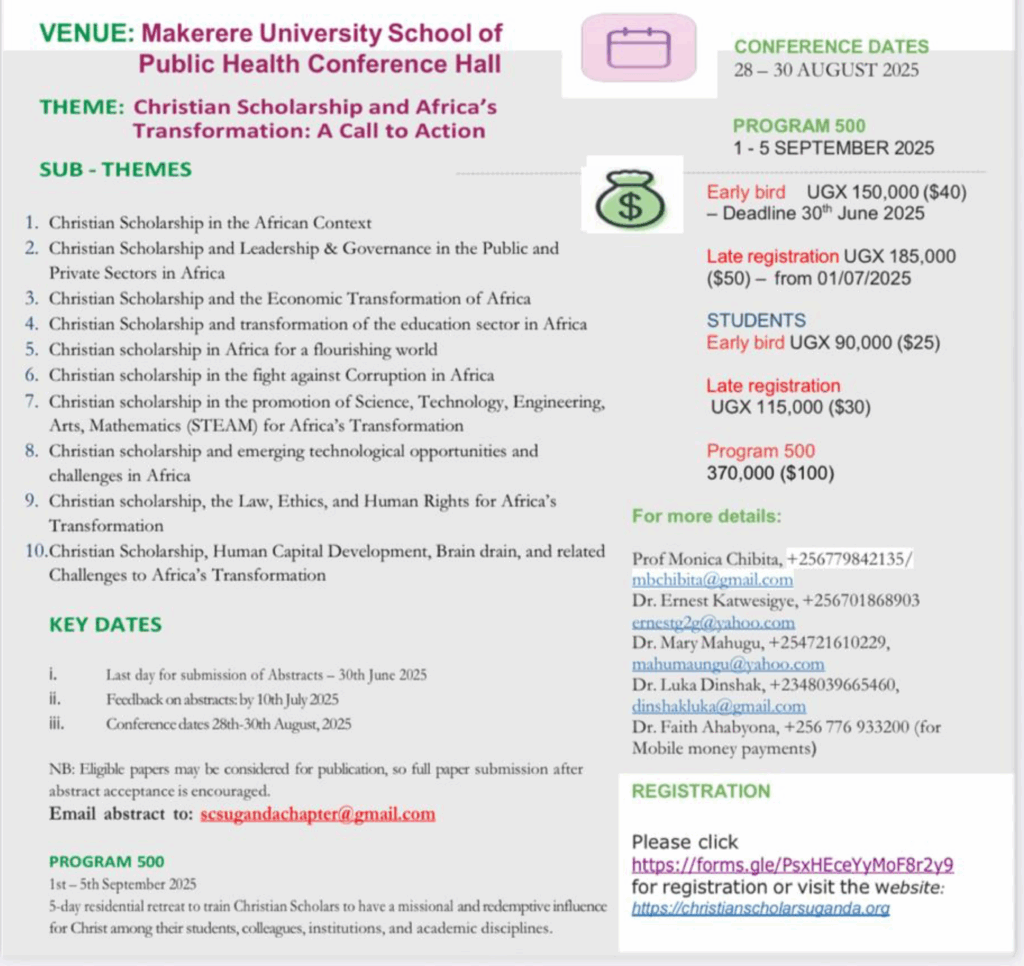
The 3rd All Africa Conference of Christian Scholars will be hosted by the Society of Christian Scholars Uganda this August. See more details below:
Lebanon Conference at Arab Bible Theological Seminary (ABTS), Lebanon
Middle East Consultation 2025: Practicing Reconciliation in the Middle East
Dates: September 23-26, 2025
From MEC website:
The purpose of this year’s Middle East Consultation is to explore interpersonal reconciliation as a significant step towards interpersonal peace and its role in creating healthier communities. This will include discussions of the successes and failures, achievements, and shortcomings of initiatives taken by pre-selected practitioners and reflected upon through a biblical-contextual lens to equip the Church to become a community of peace and an agent for reconciliation as it seeks God’s transformation for itself for societies.
MEC 2025 will seek to deepen participants’ understanding of interpersonal reconciliation theories and practices in Arab societies. It will also provide learning opportunities drawn from the experiences of various faculty members at ABTS and other Arab practitioners in the field as they come together to discuss opportunities to engage in interpersonal reconciliation initiatives across the Arab world.
Accordingly, MEC 2025 will host several participants who are experienced theologians and practitioners in interpersonal reconciliation from different Arab countries. This diverse MENA region focus group of specialists will address localized interpersonal reconciliation in three key areas of practice: confession, forgiveness, and confrontation. This will be followed by workshops on contextual and practical initiatives. Conversations will produce panel discussions on specific topics that help us develop the presented theories in a manner aligned with Scripture and address the culture of honor and shame in our societies.
Interpersonal reconciliation is contingent on the following three steps: Confession, Forgiveness, and Confrontation.
Confession: This will include confession of faith in God and in the context of confrontation, we will address confession of sins to God and to others. We will hear about how leaders addressed and practiced confession in their own lives and ministries amidst a culture of shame and honor.
Forgiveness: The role of forgiveness in the reconciliation process is key, particularly as we highlight the need for accountability and truth-telling as essential components of forgiveness in the process of interpersonal reconciliation. We will also hear how leaders addressed the challenges of forgiveness in their different contexts. Is forgiveness a journey or a decision? And what is the difference between forgiveness and pardoning?
Confrontation: Lovingly naming and identifying points of conflict or offense with others who hurt us is challenging. Here, we are seeking to apply biblical truth to issues of conflict in order to restore the person and hopefully, the relationship. We will hear about how theologians and practitioners from the MENA region have addressed the topic of confrontation biblically and practically in their own contexts and identify what hinders confrontation.
Note: Since this consultation has been postponed from September 2024, we decided to bring updates from the following nations that are or have been at war like Sudan, Lebanon, Syria, and Palestine.
Join MEC 2025
Join the conference September 23, 24, 25, and 26 (till noon) as we immerse ourselves in rich conversations on interpersonal reconciliation, a vital component of peace, as we engage in practical and contextual workshops on the theories and practices of interpersonal reconciliation.
MEC 2025 will be held in Arabic with English translation.
All workshops will be held at ABTS and in-person.
Society Library
The Library Reading Group meets the first Friday of every month. The next meeting, on Friday, 1 August at 1400 UTC, will discuss chapter 6 of the important, foundational book for our work as Christian academics, The Outrageous Idea of a Missional Professor: The International Edition, by Paul Gould and edited by an international editorial team.
In each conversation, participants share exciting insights about what it means to be a ‘missional professor’ in their local context. Various presenters lead discussions. If you would like to lead a session (or have an idea for a future topic), please contact Dr Marlene Hines, the Society Librarian, at mhines@societyofchristianscholars.org.
Reminder: Issue 2 of the SOPHIA Study Guide Series, ‘Research as Worship’, is now available in English, French, Spanish and soon to be Chinese translations! Our goal is to develop a core set of study guides that address the fundamental aspects of each of the five areas around which the Society seeks to encourage scholars to have redemptive influence in the pluralistic university.
This month’s Library Reading Corner feature, includes an annotated bibliography of 5 library resources under the library categories, Pursuing Vocational Excellence and Engaging Unbelief. These resources provide further reading for the June 2025 webinar ‘Adam’s Image: Why AI Can’t Replicate Humans’ by Dr. George Montanez.
1. ‘Technology and Theology: Finding the Real God’ by Louis C.H. Fourie
Brief Description: This is the first chapter of the publication “Engaging the Fourth Industrial Revolution: perspectives from theology…” vol. 3. Artificial Intelligence and robotics are identified in the chapter as two of the most important technological innovations during this era and a section is focused on the indications for a conversation between technology and theology.
2. ‘COG, A Humanoid Robot and the Question of the Image of God’ by Anne Foerst
Brief Description: The author presents an alternative epistemological framework for the dialogue between religion and science. The usefulness of this framework has been demonstrated through its application to the dialogue between artificial intelligence (AI) and theology. The description of an advanced AI project: Cog, a humanoid robot is presented along with its assumptions and “how the project can be enriched by theological insights”.
3. ‘African Christian Theology in the Age of AI: Machine Intelligence and Theology in Africa’ by Yogesh Awasthi and George Okumu Achar
Brief Description: The integration of artificial intelligence (AI) technologies into various aspects of human life, including spiritual and religious practices, raises profound theological and ethical questions. This paper explores the intersection of theology and AI in the context of the study and practice of theology, examining the implications and possibilities of using machine intelligence to enhance spiritual guidance and support in Africa.
4.Have We Lost Our Minds? – ‘Introduction’ by Stan Wallace
Brief Description: This is a copy of the introductory chapter to Dr. Wallace’s book which provides an overview of the main thesis of the book which is that, man is made in the image of God to have a spiritual relationship with Him despite of the neuroscientific and neurotheological explanations of the relationship between God and man.
Upcoming Webinars
Be sure to check the Webinars Page for third-party webinars that are often added on short notice and for updated presenters and topics that may be helpful in equipping you to bring the gospel to bear in your university context.
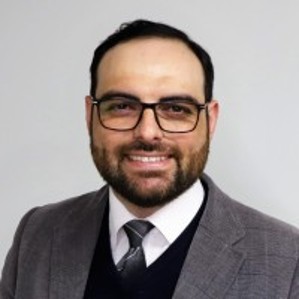
Walking Together through the Everyday Life of the University by Jaime Peña-Álvarez – Thursday, 17 July 2025 at 1400 UTC
Life in academia can be challenging and demanding. Academics face constant pressures: meeting deadlines, responding to student demands, publishing research, obtaining funding, and dealing with time and resource constraints, all with an expectation of achieving excellence. For their part, students are confronted with uncertainty about their future, family expectations, lack of maturity, poor time management and limited resources.
In this context, both teachers and students experience loneliness, stress, insecurity, anxiety and the feeling of not being understood. Given this reality, pastoral accompaniment in the university is urgently needed.
On Thursday, 17 July 2025 at 1400 UTC, Dr. Jaime Peña-Álvarez, Coordinator of Internships and Degrees in Industrial Civil Engineering and Assistant Professor at the Autonomous University of Chile, will share how the Lord has allowed him to walk alongside academics and students, both at his university and at Grupo Bíblico Universitario de Chile (GBUCh), providing support in their challenges and helping them to integrate science and faith. This is a call for every Christian academic: to be an agent of comfort, encouragement and hope, communicating the Good News of Jesus Christ in the midst of the complexities of university life.
Join the conversation and register today!
Holistic Apologetics: Re-Imagining Apologetics for the 21st Century by Seidel Abel Boanerges – Thursday, 21 August 2025 at 1400 UTC
Many Christians think apologetics is only for the intellectually gifted. Comments like, ‘I can’t argue like you’ or ‘I don’t understand philosophy or logic’ reveal how many Christians feel excluded from the conversation. Christian academics may have similar sentiments, especially when philosophy and logic are not their areas of expertise. While some have recently called for more creativity and imagination in apologetics, it still remains largely rational and verbal—creating barriers for many.
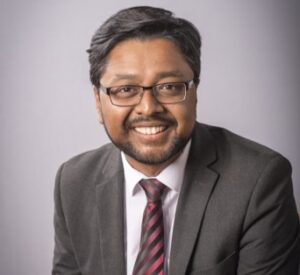
On Thursday, 21 August 2025 at 1400 UTC, Revd Dr Seidel Abel Boanerges, Dean of Ministerial Formation and Tutor in Theology at Spurgeon’s College, UK, will discuss, based on his 2025 book Holistic Apologetics, how apologetics might be reimagined through the lenses of the kingdom of God and the missio Dei. He argues that it must move beyond intellectualism and highlights the value of spiritual apologetics (healing, miracles, prophecy), artistic apologetics (literature, drama, film), and action-based apologetics (justice, compassion, solidarity). In the end, he seeks to make apologetics accessible to all, encouraging every believer, regardless of intellectual ability, that they too can be an apologist.
Register and join the conversation today!
Disclaimer: The views and opinions expressed in the Addenda are those of the authors and do not necessarily reflect the views or positions of the Society of Christian Scholars.