The Society of Christian Scholars' First Global Conference
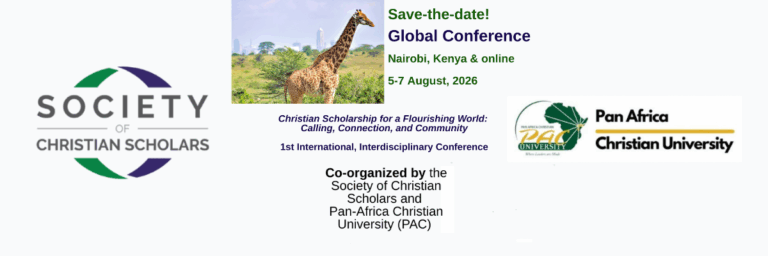
God intended humans to live in community; the first family, the nation of Israel, the Church. An interconnected world with Christ-centered leadership, enhanced communication technology and increased connectivity would lead us to expect more cohesive communities and societies. And yet, our experience demonstrates that we live in an increasingly fragmented, lonely, and divisive world torn apart by poverty, war, food insecurity, disease, nationalism, climate injustice, numerous socio-economic inequalities, crimes against humanity, and more. Christian academics are not exempt: we face these growing challenges and can also wrestle with isolation in our pluralistic universities. We need to unite our voices together thereby realizing our potential for redemptive influence in our universities, cultures, and societies. This conference to be held in Nairobi, Kenya is designed to foster these essential connections.
Towards this end, our vocation to Christian scholarship, animated by wonder and awe of God’s majesty and good creation, seeks to communicate a holistic and integrated understanding of biblical faith and intellectual inquiry. In doing so, this scholarship brings the truth, goodness, and beauty of Jesus Christ discerned in the power of the Spirit to bear on the multi-faceted challenges of our world. Rooted in the Christian principles of calling, connection, and community, this integrated scholarship bridges disciplines and perspectives, fostering holistic understanding and global engagement. It also requires contextualization to readdress local and regional concerns and particular challenges within academic disciplines.
By embracing the calling to Christian scholarship within the context of Higher Education, the conference will inspire participants to align their work with God’s kingdom purposes as part of the gospel, promoting human flourishing and advancing the common good for all. By prioritizing connections, this first-ever global conference on Christian scholarship highlights the interrelationships of humanity and creation, encouraging academic excellence, stewardship and justice. Through the cultivation of community, Christian scholars nurture collaboration and empathy, building networks that transcend divisions. This integrative approach exemplifies how faith-informed scholarship can help the university realize its potential to shape a more just and flourishing world.

Upcoming Opportunities
2026 Christian Scholars Foundation Legacy Grant Opens 20 October 2025
Available only to scholars in the U.S. and Canada
Global Scholars, one of the principal partners of the Society of Christian Scholars, will again award one Christian Scholars Foundation Legacy Grant in 2026. The grant will be awarded to a junior faculty member in the U.S. or Canada. The purpose of this grant is to advance Christian scholarship, encourage Christian scholars who are seeking to integrate Christian faith with their academic endeavors, and nurture Christian faculty as they strive for wider recognition in and beyond the academy.
Applicants are required to be members of the Society of Christian Scholars and the Emerging Scholars Network. The 2026 Christian Scholars Foundation Legacy Grant will be $10,000. More details and the grant application are available at the Society of Christian Scholars member site.
Questions concerning the grant may be sent to Dr. Hannah Eagleson, Christian Scholars Foundation Legacy Grant Director, here. You may read testimonials from past recipients here and interviews with several recent recipients on the Emerging Scholars Network Blog: Carrie Bredow (2016), Jill Ellenbarger (2017), Eleanor McGlinchey (2017), Jennifer Hawk (2018), Derek Thompson (2019), and George Montanez (2023).
Next Spiritual Formation Meeting
On the second Wednesday of every month, Dr. Nita Kotiuga will lead a group exploring various forms of experiencing God together through prayer. The next prayer meeting will be on Wednesday, 12 November 2025 at 1400 UTC. This will be a time of listening and teaching, followed by sharing. Depending on the type of prayerful experience being explored, meetings will last 1 to 1.5 hours.
Participants will explore the following as a beginning to our journey together.
Praying through different styles of prayer (these could be several sessions)
Exploring the benefits of journaling
Scheduled times to pray for each other
Learning how to contemplate Scripture
Learning how to meditate with Scripture
Exploring a prayer walk
Exploring spiritual pathways to discover a personal style
Exploring individual spirituality practices for the Enneagram
Be sure to have your Bible readily accessible as well as pen and paper, because handwriting slows us down to help us express more accurately how we feel.
Dr Kotiuga says, ‘I am looking forward to engaging with each of you, as we receive God’s love for us and respond to him with love.’ If you have any questions, please feel free to contact her at nita.kotiuga@bgu.edu.
Be sure to register for this exciting new opportunity!
Society Library
The Library Reading Group meets the first Friday of every month. The next meeting, on Friday, 7 November at 1400 UTC, will discuss Issue 1 of the SOPHIA Study Guide Series. If you would like to participate, be sure to register for what will be a fruitful conversation! Any questions, contact Dr Marlene Hines, the Society Librarian, at mhines@societyofchristianscholars.org.
This month’s Library Reading Corner feature, includes an annotated bibliography of five library resources under the library categories, Loving God with the Mind, Theology and Academy, and Growing Spiritually. These resources provide further reading for the September 2025 webinar by Prof. Elmer Thiessen, The Importance of Intellectual Virtues for a Polarized World.
1. Add to Your Scholarship: Challenges for Christian Scholars to Academic Discipleship by Danny McCain
Brief Description: This is a keynote address by Prof. McCain at the ECWA Scholars Fellowship inaugural summit in 2018 at Jos, Nigeria. The intellectual Christian virtues that were the focus of this address, as guided by 2 Peter 1:5-8, included faith, integrity, knowledge, discipline, perseverance, godliness, mutual affection and love as they relate to the duties and responsibilities of a Christian university professor.
2. In Pursuit of Intellectual Integrity by Elmer John Thiessen
Brief Description: ‘This article rigorously and insightfully examines three intellectual virtues–love of knowledge and truth, intellectual humility, and open-mindedness–that are essential to Christian maturity and powerful in overcoming strife, contention and polarization.
3. Paul’s Intellectual Courage in the Face of Sophisticated Unbelief by Thomas K. Johnson
Brief Description: This article shows Paul’s intellectual courage in confronting the entire gamut of Jewish and gentile worldviews. Basing his argument on Romans 1:16-32, Johnson shows Paul’s understanding of the human condition and the tendency to suppress general revelation and absolutize partial truths. Faced with a variety of worldviews, Christian scholars today need a strong intellectual courage to confront the idols of the modern university.
4. Title: How Philosophy Teaches Humility by Bruce Barron
Brief Description: The blog discusses the virtue of humility through the lens of a Christian philosopher. It concludes that as Christian scholars, we should reflect carefully about how we treat others and exhibit an empathic response to situations. Barron suggests that grace, forbearance, and patient instruction may be better tools in addressing a problematic situation involving colleagues, students or others rather than the application of discipline or rebuke.
5. Title: Jesus Christ and the Life of the Mind by Mark A. Noll
Brief Description: Noll maintains that if evangelicals take the Bible seriously, they will also take the general advance of learning seriously. Noll says, ‘Coming to know Jesus provides the most basic possible motive for pursuing the tasks of human learning.’ Moving from the general to the specific, Noll argues for a Christ-centered structure that grounds an ever-expanding scholarship. His specific examples come from history, natural sciences, biblical studies and theology.
Upcoming Webinar
Be sure to check the Webinars Page for third-party webinars that are often added on short notice and for updated presenters and topics that may be helpful in equipping you to bring the gospel to bear in your university context.

Perceptions and Determinants of Entrepreneurship in a Christian Environment: A Science-and-Faith Analysis by Albertine Bayompe Kabou – Thursday, 20 November 2025 at 1400 UTC
Poverty is a real challenge for African countries, where unemployment rates are often very high. Faced with this situation, many people, especially young people, live in very difficult conditions. Careful inquiry grounded in a solid understanding of social development and entrepreneurship can discern why Francophone Christians are so marginal with respect to economic development in their countries.
On Thursday, 20 November 2025 at 1400 UTC, Dr Albertine Bayompe Kabou, Lecturer in Economics at Université Assane SECK de Ziguinchor in Senegal, will discuss her analysis of Christians in Francophone African countries and why they seem to have a passive attitude towards entrepreneurship. Their lack of involvement in entrepreneurship can find roots in the continent’s history of slavery and colonization, but also in other sources such as the educational system, the sociological characteristics of Africans and the influence of religious beliefs.
The objective of this presentation is to explain the perceptions of entrepreneurship among Christians in French-speaking Africa. The interest of this research is twofold: (1) to address the causes of the passivity of French-speaking African Christians in entrepreneurship, and (2) to identify ways to make them more present in economic development, with the aim of improving their living conditions and financing mission and evangelization projects.
Join the conversation about how entrepreneurial business can be a tool to effect real change for the well-being of your society by registering below!
The Q&A period will be in both French and English. It will be moderated by Laurent Kayogera, a scholar of communication sciences, a Society leader in Burundi, a training coordinator for the Burundian IFES movement, and a senior catalyst in the Logos and Cosmos Initiative, and Stephen Ney, a scholar of literature from Canada who teaches academic writing and critical thinking in Sierra Leone and coordinates theology-and-science training for the IFES Logos and Cosmos Initiative.
Disclaimer: The views and opinions expressed in the Addenda are those of the authors and do not necessarily reflect the views or positions of the Society of Christian Scholars.